

381·
5 days agoEFF supporter for years. Have so many of their t-shirts (amazing designs, btw). Cindy Cohn is the real deal. Anyone online should go pay attention to them.
EFF supporter for years. Have so many of their t-shirts (amazing designs, btw). Cindy Cohn is the real deal. Anyone online should go pay attention to them.

The problem with CAG is not just that it hogs memory, but to keep it fresh you have to keep re-indexing. If the corpus is large and dynamic, it can easily fall out of date and, at runtime, blow out the context window.
GraphRAG has some promise. NVidia has a playbook for converting text into a knowledge graph: https://build.nvidia.com/spark/txt2kg
It’ll probably have the same issues with reindexing, but that will be a common problem, until someone comes up with better incremental training/indexing.
Looks interesting. Will give it a whirl on my home server.
In this article, they talk about bringing up a local RAG system to let people run an LLM off a large document corpus: https://en.andros.dev/blog/aa31d744/from-zero-to-a-rag-system-successes-and-failures/
Wonder if this, connected to something like that, and wrapped in an easy end-user friendly script or UI could be a good combination for a local, domain-specific, grounded knowledge-base?
When this automation fad showed up, many people pointed out that there would be plenty of cases where the training data just didn’t cover edge-cases. Problem is, life is FULL of edge-cases. This is where humans are uniquely good at improvising and adapting in real-time, when faced with previously unknown situations.
In fact, you can argue humans are really, really good at handling exceptions to the rule. Pretty much the textbook definition of “creativity.”
In the dotcom era, the push was to create lots of free services. Once you had enough users, you wanted to see how many would be willing to pay for it. There was a formula that justified getting more investment (it varied by domain). Back then, almost nobody other than Amazon survived the hard shaking of the tree.
We may be coming up to the point where customer acquisition through free service ends. Whatsever is left standing will move to the next round.
Everybody else gets dropped on the floor.

Was looking at a used car online. Found a site that had option to ‘reserve’ the car until paperwork was done. Started innocuously with email and phone info, to text updates. Fine. Then it asked to verify info, with scans of driver’s license.
Persona.
Noped right out.
👊🏽 Sonic.
MySpace reboot vs Spotify.
Beautiful works!
If viewed on an iPhone or iPad, you can take it into AR mode and drop the piece on a table in front of you, then walk around it. Don’t know if that works on Android.
XKCD needs to update Little Bobby Tables (https://xkcd.com/327/) to include prompt injection.
The way money-laundering works, you take ill-begotten funds and somehow churn it into legal tender in ways that can’t be traced back to the source. Another angle is to create corporate entities that show loss against gains, so you can deduct and don’t have to pay taxes on your windfall profits.
In the olden days, these were physical, degrading assets. Like strip malls, real-eestate, and dodgy, money-losing businesses that somehow stuck around forever. At the end, you were stuck with physical entities you couldn’t unload.
Crypto and NFT were just digital variations of the same financial model, minus the hassle of having to manage the property.

Given that the infrastructure description included the DataTalks.Club website, this resulted in a full wipe of the setup for both sites, including a database with 2.5 years of records, and database snapshots that Grigorev had counted on as backups. The operator had to contact Amazon Business support, which helped restore the data within about a day.
Non-story. He let Terraform zap his production site without offsite backups. But then support restored it all back.
I’d be more alarmed that a ‘destroy’ command is reversible.

The math adds up. If you take out all the whiners, you get left with a large cohort of sunny optimists.
There’s a difference between ‘repairable’ and ‘upgradable.’ Most of the comments seem to conflate the two. Lenovo isn’t doing a Framework.
It’s a smart move. Differentiates them from other laptop-makers for corporate IT, who can do the parts swaps themselves. Also smart is associating the brand with iFixit and working to get a 10/10. That’ll be what sets them apart from all the others, at least for the next year or two.
Was self-hosting gitlab or foregejo not an option?
At some point, some DIY person will come up with a way to disable these things in their presence.
And they will make bank.









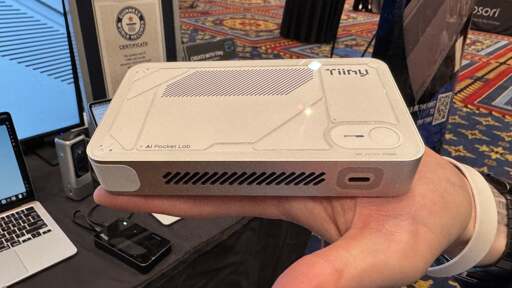






Remembered I had an unopened Pi5-8GB on the shelf.